316. Bowie book

Just finished the most compelling book I’ve read for many years. ‘David Bowie: A Life’, by Dylan Jones.

It had me turning the 500 or so pages deep into the night, hardly able to comprehend the depth and width of experience that Bowie packed into his 69 years. The numbers alone tell of a prolific musical artist. 27 studio albums released and a whopping 128 singles, plus numerous live albums.

On the big screen, the guy starred or took a role in almost 40 films. He painted and sculpted. The scope of his drive and ego – and the determined patience that he displayed to reach his goals – was way off the Richter scale.

The book tells you how he was perceived by those who knew him best. Using 180 interviews, and lots of words from Dave himself, it builds a chronological picture from his boyhood in South London through to his untimely demise in 2016. All the delicious detail has left me more of a fan than ever, playing a span of old Bowie albums every time that I sit at my desk.

One aspect that blew my mind was the bloke’s sex life. It’s no spoiler to reveal that Bowie bedded what seems to have been thousands of humans, including a fair sprinkling of males. That thrust poked priapically through his music and his words. It jutted out in taboo-breaking stage theatrics that made Elvis look like a boy scout.

Bowie’s real and artistic explorations of sexuality blazed a trail for untold millions of the lonely, the unsure, and the marginalised. Paint your face, stack your heels, wear your brightest colours, you beautiful, gorgeous peacocks. Kudos to Dave. Fittingly, the book dwells longingly on the watershed moment in spring 1972 when he performed ‘Starman’ on TV (Top of the Pops), just after I had turned 15.

David had caught my ear with his ‘Space Oddity’ single back in 1969, but not my eye. Now he stood looking like a space-age Robin Hood, lipsticked and palely powdered, as he sung of the ‘Starman’ waiting to come and meet us. I had no concept of androgyny, but my gut knew, as he and guitarist Mick Ronson cuddled and caroused together at the mike.

Sex was never more than a half-undone zip away in the themes of Bowie’s 1970s run of singles and albums, which showcased endless amalgamations of musical styles.

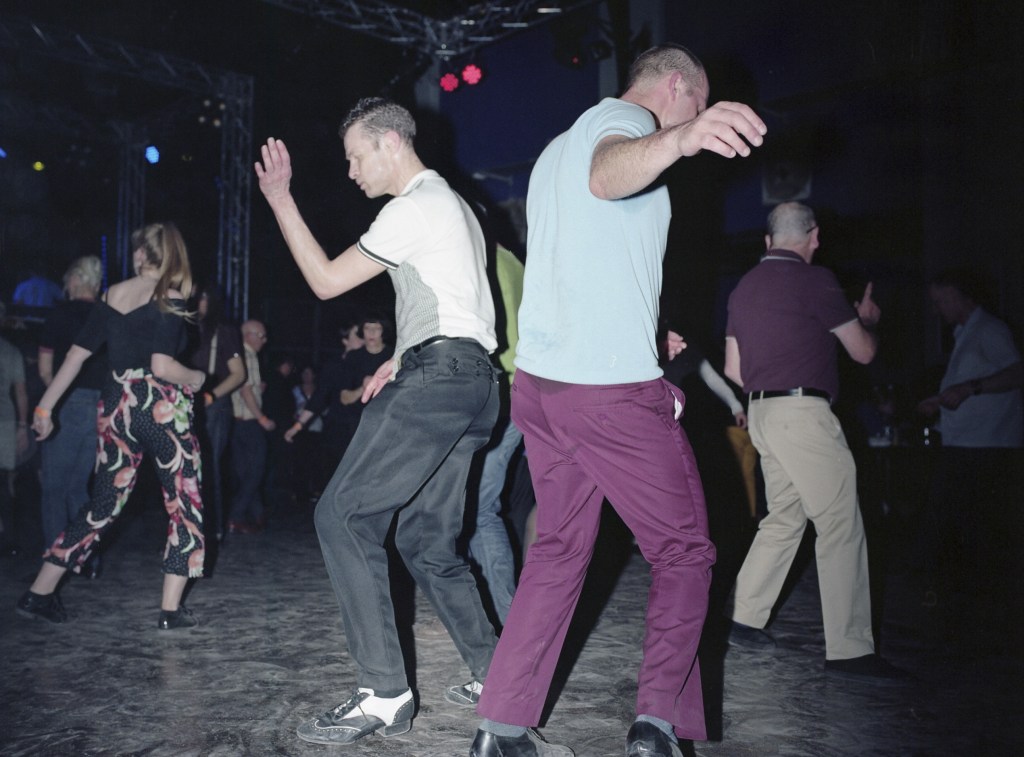
I remember dancing freely to ‘Golden Years’ in a Majorca nightclub in 1976. Flailing around and letting it hang out, joy erupting from every pore. Was that soul? Funk? Pop? Rock? I caught him live in 1978. At Stafford Bingley Hall, when he was in his Thin White Duke phase. Emaciated from his coke intake, singing of hollowed-out romances.

His music was a constant soundtrack to that era of my life. It still seems like yesterday when the eerie, futuristic sound of ‘Warszawa’ could be heard creeping out from under a friend’s bedroom door as he revised for his 1978 university finals. Bowie was living in Berlin at the time, mentoring Iggy Pop, excavating the nightlife of the city where all cultures met. And where he made the epic ‘Heroes’.

His biography doesn’t flatter. It tells over and over of an eclectic musical genius and sex addict who would be your friend, right up until your sweaty or metaphorical pound of flesh was mined. Charming you and stealing your energy and best ideas like a magpie, keen to stay ahead of every musical curve. Copy, camouflage, mix up, move on. Different hairstyle, new outfit. Doffing his hat to punk, crooning with Bing Crosby, roping in Luther Vandross to make the transformation from glam rock superstar to Philly soul singer.

Difficult not to applaud his leaps of musical creativity. And once he was in the studio, it was head down and do the job. Usually he nailed the vocals on the first take, however difficult, sometimes the second take. However wasted he might be. He had the additional gift of trusting his band members to play it as they thought best.

Talented in so many ways. But, like many of his peers, he was stiffed for money by managers and the music business until he wrested control. In 1997, Bowie ‘securitised’ his future royalties in financial markets through so-called ‘Bowie Bonds’ which brought him a cool $55 million. He then bought back the rights to his early catalogue from his former manager, Tony DeFries, thereby guaranteeing that he would eventually receive all future income from those recordings. 

I liked the tales of how Bowie finally relaxed with age, and wealth. The descriptions of his joy in finally finding a new marriage partner, his second wife, the Somalian Iman Mohamed. I liked how, to mitigate his wayward fatherhood to his son, he took the best part of a decade away from music to bring up his daughter Lexi.

And how, in his final years, he was widely seen by friends as returning to his original unmasked self, Davy Jones, the bright, affable bloke from Brixton and Bromley. Who quietly sat in New York coffee houses and bookshops in shades and a hoodie, liked to help other musicians, and developed a wonderful knack of making awkward and shy people feel at home in his company.

And I sadly adored how he bowed out with such style and enigma. Releasing the amazing but dark ‘Blackstar’ album, on his 69th birthday, two days before his demise from liver cancer.

I word-checked all my blogs. 11 of the previous 315 have references to David Bowie. One mentioned his cameo role as an FBI agent in Twin Peaks. Another flagged up a lovingly crafted painting of Dave that sat proudly above the optics in Southend-on-Sea’s Railway Hotel when I last visited, in 2013.

To accompany my descriptions of Covid-19 lockdowns as a ‘Rip in Time’, I fleshed out blog 283 with a verse from Bowie’s ‘Time’. From the awesome ‘Aladdin Sane’ album, which is my wife’s favourite by some distance. 

Time, he’s waiting in the wings
He speaks of senseless things
His script is you and me, boy

Time, he flexes like a whore
Falls wanking to the floor
His trick is you and me, boy

Always ahead of his time, head and shoulders above the trailing pack.

315. The Dark Lord

Most days we wade in pools of mundanity. Wearily waiting for something to lift us up and out into a sky bright with meaning.

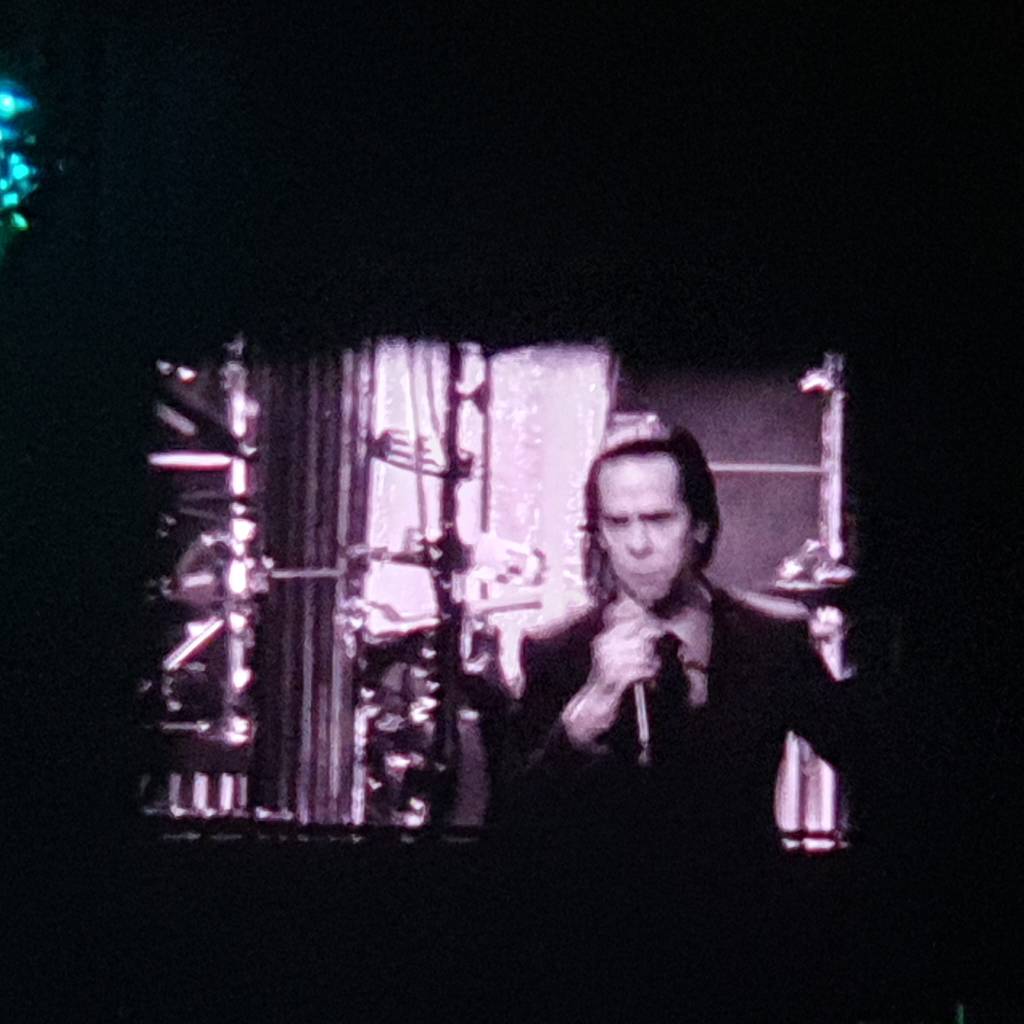
On 9 November, I went with my missus to watch Nick Cave and the Bad Seeds play at the O2 arena in London, as part of the band’s tour to promote their Wild God album.

Finally seeing Nick and his band play before I die was a big item on a very small bucket list. He didn’t disappoint, completely compelling our attention for around two and a half hours.   

Maybe Nick is like Marmite. I’ve loved his music for about 20 years, more so with each passing year. That voice alone. So powerful and poignant, plaintive and purging. Then again, I know people who find little to like about him.

Many will know Cave from Red Right Hand, the song that opens the Peaky Blinders TV series. Each of his albums contain similar epics that stand the test of time. Beautiful tunes, weeping sagas, soaring ballads and hard-hammering tracks that burst with poetry describing the magnificence of love and sex and God, amid the constant presence of hate and death.

What a childlike thrill it was to see him stride onto the stage. The Dark Lord, tall, thin, larger than life, kitted out in his standard close-fitting black suit, to match the hair. And a ribald hello shouted out to break the ice…..“Fucking London!”

Nick has been polishing his craft for nearly 50 years. It showed. The set was tightly orchestrated with stunning black and white screen visuals; yet the show felt improvised throughout. Especially his interaction with the fans at the front, constantly touching hands and exchanging banter. Miraculous intimacy with a 20,000-strong crowd. My mate Jono, who saw Nick in Cardiff several days earlier, said that he had never seen someone with such a profound link to his audience. He reckoned that “all those gathered joined in an act of collective worship at the breast of Nick.”

Maureen was bowled over by Nick’s co-pilot Warren Ellis, the band’s anchorman. Musical genius with wild white hair and beard who writes the tunes, works his synths, guitars and violins (the latter until the strings fray), stands on his chair, laughs a lot and sings in the most incredible ethereal falsetto voice, a ghostly counterpart to Nick’s baritone.

There was hardly a minute when I wasn’t thinking “you dizzyingly lucky bastard Kev”. Goose bumps erupting, seeing two absolute maestros doing what they love, at the top of their game. No drugs needed to feel the endorphins crashing in, non-stop. Another high cloud of delight for me was the performance of his four black backing singers. A choir clad in white, whose harmonies were setting off bacchanalia in my head.

Music crowds always want to hear old favourites. Mine was Jubilee Street. The tale of a man brought to his knees and out of this earthly dimension by his sex addiction. Starting with the slow, accelerating build of a guitar riff, it reaches a frenzied musical orgy of piano, drums, violin beneath a thick wall of backing vocals. “I’m transforming, I’m vibrating, look at me now!” Nick sings, running left to right, skipping to the piano and back.  I’m almost popping out of my body watching this magic. He’s 67, for God’s sake, yet still rocking out like somebody half his age.

Another enrapturing performance was Tupelo. The town in Mississippi where Elvis was born. The song pivots around the storm that accompanied the birth of the King. In fact the song is that storm, the rain and thunder, the birth pang of a whole new music. Drums to shake and stir your insides, and then Nick’s voice smashing and screaming and crying out the emerging new religion.

In a clap-board shack with a roof of tin. Where the rain came down and leaked within.

 A young mother frozen on a concrete floor. With a bottle and a box and a cradle of straw.

Well Saturday gives what Sunday steals. And a child is born on his brother’s heels.

Come Sunday morn the first-born dead. In a shoe-box tied with a ribbon of red.

Tupelo-o-o! Hey Tupelo

Cave twists and froths like a Baptist preacher who has lost his mind to the Devil.

Nick belted out a whole string of his utter bloody masterpieces: From Her to Eternity, Red Right Hand, Weeping Song, White Elephant, Into My Arms. The new album material found an equally rapturous reception. Crafted to a slower, more mature feel. Never forgetting his loss of two children in the last nine years, nor the love of his wife. Shot through with gospel ethos, dark wit and an evolution into empathies he lacked as a younger man.

One line from the new album sums it up: “We’ve all had too much sorrow, now is the time for joy”

The new track that fires me up is ‘Conversion’. Haunting piano and organ, words that allude to the lingering power of older religions, Warren’s spectral vocals, and then the explosion of the song into an incanting blowout that confirms the step into the liminal, again and again.

“Touched by the spirit, touched by the flame.”

Above everything else, I was overjoyed that Maureen loved the show. Never a fan like me, she was in tears at two of the first four songs, ‘Wild God’ and ‘Children’. She whispered the word shaman in my ear. I wasn’t arguing.

I could go on. The band did, for a full 150 minutes, until a lone Cave finally departed the stage. It was the perfect gig, impossible to better.

We followed up with a drink in a local bar. Chatted with an Irish guy who said the show was ‘Biblical.’ All I could think was that we had a forever memory. How often can a couple in their mid- to late-60s get to experience being enthralled, bewitched, beguiled and totally ravished?

Jono gets the final word: “The reviews in no way exaggerate the transcendental nature of the experience,” he said. “I don’t know if I ever want to see another gig. It’s a pinnacle. Unsurpassable.”

Time moves on, memories fade. But I can still play the Wild God CD, re-invoking our passionate night with the Dark Lord.

314. My favourite cousin

My cousin Martin called me in January. I hate talking on the phone, but his calls always made my heart leap with joy. He was a great teller of stories, but also knew how to listen, and not to judge.

When necessary, he was direct. He didn’t beat around the bush on this occasion. But he did hesitate, trying to find the right words, and I sensed what was coming. He was 72 and had gone through several health battles in his later years. And was now diagnosed with cancer in the bones, lungs and liver. Having previously gone through weeks and weeks of chemo for prostate cancer, he had no desire to re-endure those agonies for the sake of a bit more time alive.

The doctors had given him a few months. “I can have very strong pain killers as it gets worse. I’ve chosen not to battle it.”

I got it. More importantly, his close family didn’t oppose him. Mart and I had a long phone conversation about a month later, talking about everything under the sun. And then a much shorter chat, in March. I wanted to drive over from Brentwood to Saffron Walden to see him, but he insisted no. He was already in too much pain.

He left this world on 3 May, quite peaceably. Maureen, my brother Neil and I attended his funeral on the 24th. The crematorium was so packed that some mourners had to stand.

I wasn’t surprised. I had deeply enjoyed his company over the years, and he seemed to have friends from many walks of life. It hurts me even now that he isn’t around anymore. I think about him sometimes on my walks. How can he not be here?

I don’t have many childhood memories of Martin. His dad had died very early, in a tragic RAF air crash, so that Mart had next to no memory of his father. He holidayed once with us at Butlins, somewhere, with his sister and my Aunt Elsie. Maybe he made a few visits to our house. Always bigger and stronger than me. Did he get a motorbike at some stage? Mum always talked about him as if he was a bit of a maverick, which got my interest going.

And then, in about 1983, we hooked up again at my cousin Susan’s wedding. Bumped into each other in the gents. He was in his early 30s, witty, confident, handsome, friendly and had a good-looking wife. Stories of drunken times with mates rolled off his tongue. Best of all, he was well paid for climbing the sides of tall buildings. A steeplejack, goddamit!

He instantly became my favourite cousin, because he seemed happy to not be doing any of the corporate shit that is held out to us as the good life. I’ve always liked outsiders and rebels.

He came along to my wedding reception in 1985, arriving before this drunken groom. I recall thinking I wanted to somehow spend more time getting to know him.

It happened eight or so years later. He became a member of my Gameplan betting syndicate, with a £500 stake, no less. He brought the cheque over to Chelmsford, along with a vicar’s daughter that he was squiring, the lovely Kirsty. Martin stuck with Gameplan through its many ups and downs, encouraging me when I felt fragile about the inevitable losing runs. I’ll always be grateful for that. I’m glad to say he came out a few quid ahead at the end. Maybe that’s why he helped paint two of our houses in Chelmsford, free of charge.

When his son Paul got married in Ireland, it was a huge pleasure to take Maureen and the kids across for the week. More good memories, especially to sit and drink with Martin and his mate Les and a few others at the hotel.

He loved singing and playing the guitar. Him and Les performed in pubs. Me and a mate went to watch him one evening. They did great Beatles covers, especially the harmonies. Martin joined Neil and I for a curry in Chelmsford a couple of times, and he would regale us with stories about his quite regular busking around London’s tube stations.

He even got to play at his own funeral! A very chilled acoustic version of Slade’s ‘Cum on Feel the Noize’ that he had recorded some time ago on a cassette. It was placed on a loop at the wake. It felt like he was next door.

He seemed to live naturally near the edge. His love of poker took him out to Las Vegas a couple of times, one of which saw him become so ill that he needed an operation. The local hospital performed it despite his lack of medical cover. The costs were enormous, many tens of thousands of dollars. He phoned Paul and his daughter Louise to come and get him almost immediately, and somehow flew back to England without his finances being penetrated. I believe he then had to jiggle some of his assets to ensure that any US legal action to recuperate the money was not seen as worthwhile.  

Maverick or not, he was a family man through and through, who loved his mum. He made a lovely speech at her 80th birthday do, and another tearful tribute to Elsie at her funeral. I finally got to see most of his extended family in 2016 when he came over to our Great Waltham home with his daughter, granddaughter and great grandkids.  

They all bubbled over with gratitude for what a kind and brilliant dad, grandad and great grandad he was. He gave up countless hours to look after his younger brood, all the unsung after-school and weekend stuff that goes under the radar, to help out. Maureen remembers him as “a lovely, gentle man who was great with kids”.

The bloke was just so easy to be with. More recently I was flattered by his praise for this blog. We had some great phone chats in recent years, which I miss tremendously. 

In his final month, as I couldn’t visit, I wrote him a letter telling him what pleasure his company had brought me down the years. I concluded: “I don’t suppose we will see each other again, so I wanted you to know all this. I can’t imagine how you are feeling about the days and weeks ahead, but if my words can make even a small difference, then I’m glad.”

But he never received it, as the Royal Mail were engaged in a series of very lengthy strikes. It arrived after his passing.

I was gutted. But he knew he was loved by so many.

313. Grace’s Walk

It took 17 months, but I knew that a blog would eventually burst the coffin and find the light.

We moved back to Chelmsford six months ago. Our house sits at the edge of a relatively unknown side of town, so it was important that I found new walking routes. Getting out each afternoon stops me climbing the walls. Stops me looking at various-sized screens and keeps me fit.

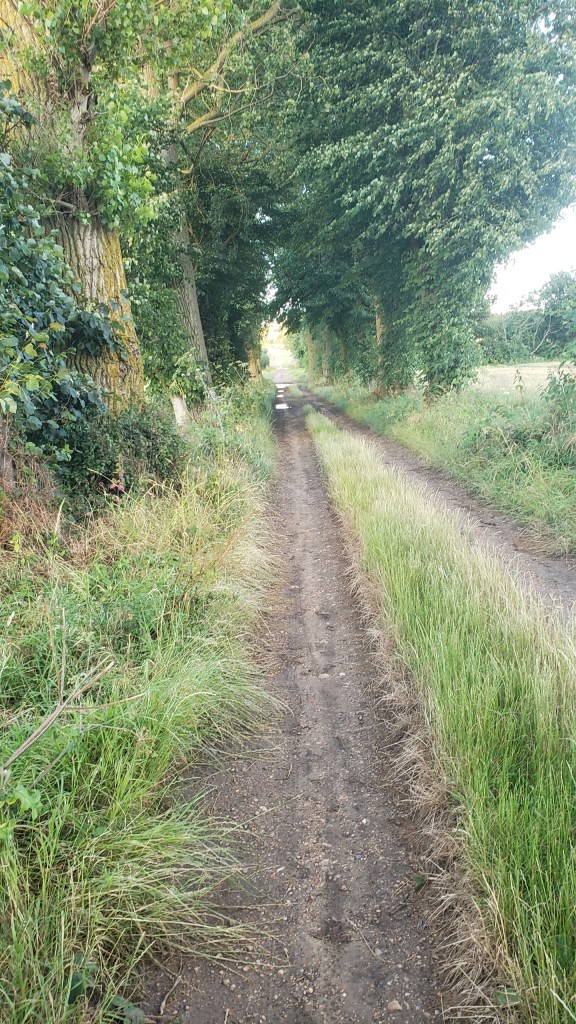
I soon found a good march, out across the River Chelmer and several fields to a farm track known as Grace’s Walk. This is a very straight mile and a quarter, with a plain stone bridge over a stream halfway along.  

At the end, there are various routes up to Danbury, one of the highest points in Essex, with a choice of six pubs to take rest and refreshment.

On the way to one, several months back, I discovered a building smack bang in the middle of nowhere, going by the name of Little Baddow History Centre. Very nondescript, utterly quiet, and offering my tired legs a seat by an old graveyard. Absolutely perfect for closing the eyes and meditating, as no humans seem to use the place.
I paid my third visit on Wednesday 13 November. A cold afternoon, with the autumn darkness descending too quickly on the local country lanes. The meditation wasn’t quite as good as hoped. Too many noises in the trees.

Walking back, at around 5 p.m., the near-full moon was spectacular, brilliantly lighting my way back down Grace’s Walk in the post-dusk. It warranted a picture, so I stopped a few hundred yards past the bridge. Pointed the phone camera back down the track and upwards. Took the picture below and was about to take a second when I noticed that the camera screen was showing something that seemed to be wobbling in the middle of the track, about 80 yards away. I looked up from the phone but couldn’t see much. My spectacles might have lost sharpness over the past year.

Because I didn’t have a high-vis jacket, it was a little scary to think somebody might be riding a bike towards me in the dark, or perhaps running. Grace’s Walk hosts plenty of mountain bikes and joggers.  My phone battery was very low, so I didn’t want to use the flashlight. I walked on, but kept turning around so that I could step aside if somebody came past. Reaching the road where Grace’s Walk ends, I waited for at least 5 minutes to let whoever might have been behind me pass. Nobody came.

Back home I looked hard at the phone picture. WTF is that mid-track? Enlarge the pic and what do you see? Damned if I know for sure. There was no water on the track for the moon to bounce off, due to weeks of dry weather.


Like a good 21st century drone, I turned to Google. I tried the word combination of ‘ghost Grace’s Walk Chelmsford’. And quickly found that a Dame Alice Grace had drowned herself at the bridge over one hundred years ago, to escape an unhappy marriage, and was reputed to haunt the track, where her phantom is said to ride a horse. The bridge, where I have sat and dangled my legs, is frequented by ghost hunters, FFS.


I remembered that I had read all of this, at speed, a few months back, but had paid little heed.

Son Rory and daughter Lauren said that they now want to walk down there with me one night. I have not been back alone. I’m waiting until spring is here and the days are lengthening.  

312. Flying Together

Dad’s funeral was two weeks ago. During my speech, I surprised myself by choking up when recounting my first vivid memory of my father.

It took what seemed like ages to stumble and tremble through the words: “He helped me to fly, at our house in Hadleigh.”

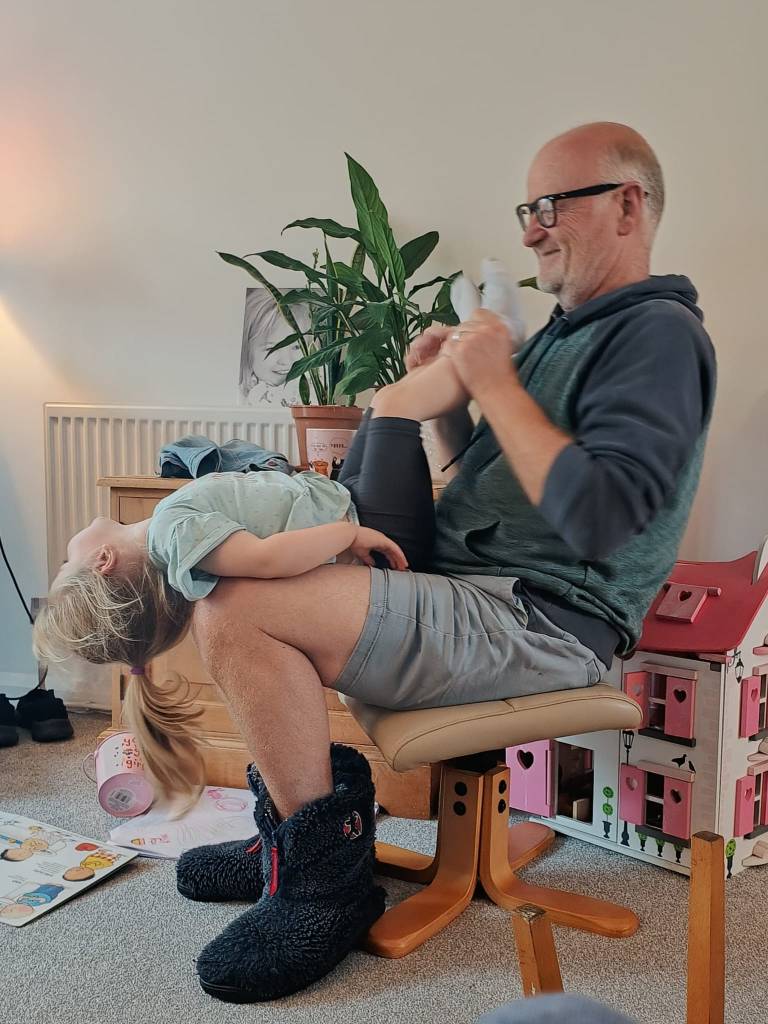
I continued: “Maybe I was three? Dad would lay on his back in the lounge, draw his knees back to his chest, and get me to sit on his feet. Then he would propel me up and across the room. One time I flew so high I hit the lightshade. While I was screaming with laughter Mum stormed in and read us the riot act.”

I thought about it in the following days. Why had it moved me so much?

At some point I realised with a quiet “whoa” that the first story Dad ever told me was about how Icarus flew too close to the sun, causing the wax on his wings to melt. The feathers came loose, and Icarus fell to his death.

Something got in my system. A while later I spent hours in the back garden building myself a plane. Using old bits of wood and scrap metal. It had wings, a fuselage and cockpit. I truly believed it would lift off over the neighbour’s fence and into the blue yonder. I installed myself and gave the command. When it stayed grounded I was heartbroken.

Dad carried on helping me as I grew up. And learned my limitations.

It’s funny how things come full circle. In his last year I worked out a way to help Dad sit up in bed for his drinks, as his body grew weaker. I would nestle into his neck, and lock my arms under his armpits, before lifting him up off the bed and backwards. We used to laugh together at the effort required. “I flew through the air,” he would chuckle.

Perhaps, in the end, we helped each other to fly, in big and small ways.

311. Hollow time

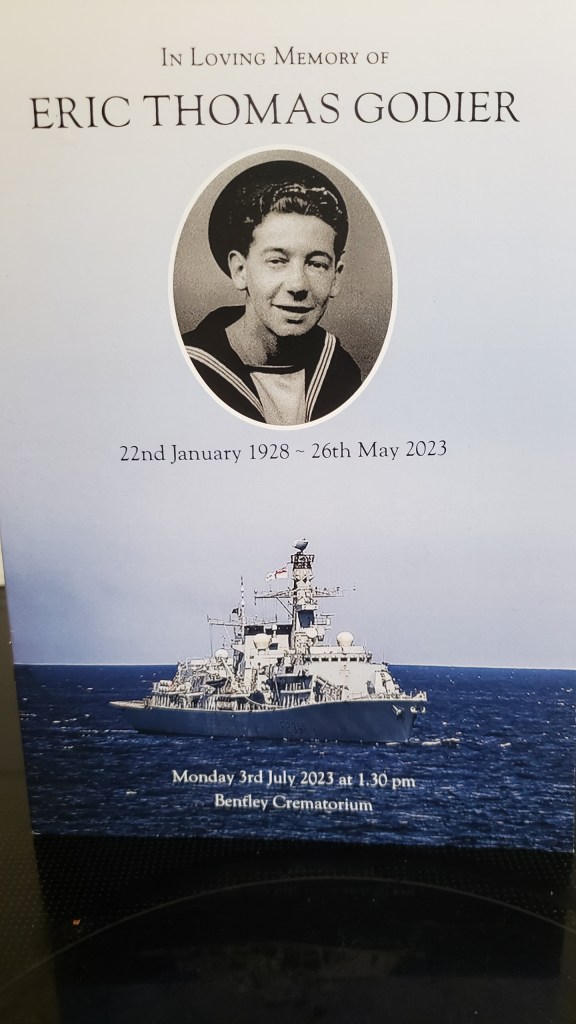
My dad passed away last Friday, 26 May. After several days of accelerating physical decline, Eric took his last breath at 9.17 a.m. He had reached the ripe old age of 95 years and 4 months.

Having looked after him for over three years, I still don’t quite know what to do with myself. There is an absence in the house. A hollow feeling. But also a real sense of relief that his suffering has come to an end. Dementia is a cruel disease, one which reduced my father to a shell of his former self.

May you rest in peace, Eric Thomas Godier.

310. Fox

I have something massively joyful to report.

I’m a grandad for the first time!

Daughter Lauren gave birth to the cunningly named Fox on 29 January, accompanied by her husband Chris and my wife Maureen. Six pounds and 13 ounces of new life. I’ve only met my beautiful granddaughter once, given my care duties, but what an unadulterated pleasure to hold a young baby again.

She’s doing well in all of the areas that you would hope. Feeding, sleeping, yelling and excreting like a trooper.

Lauren and Chris have decided to keep any images of the lovely Fox away from the Internet. I respect their choice. In the absence of a picture, I’ll reproduce my blog about Lauren’s birth, just over 35 years ago.

It’s worth relating an intriguing footnote. After being told of Fox’s birth, I spent happy hours at home humming a song from the late 1970s, by the US band Television. The song title…….. ‘Foxhole’.

Later in the day, my friend Jono told me that the band’s creative force, Tom Verlaine, had just died.

Synchronicity! Or just coincidence. The universe works in mysterious ways. The foxes at the end of our garden have been howling with an unusual vigour in the last couple of weeks.

309. Gone

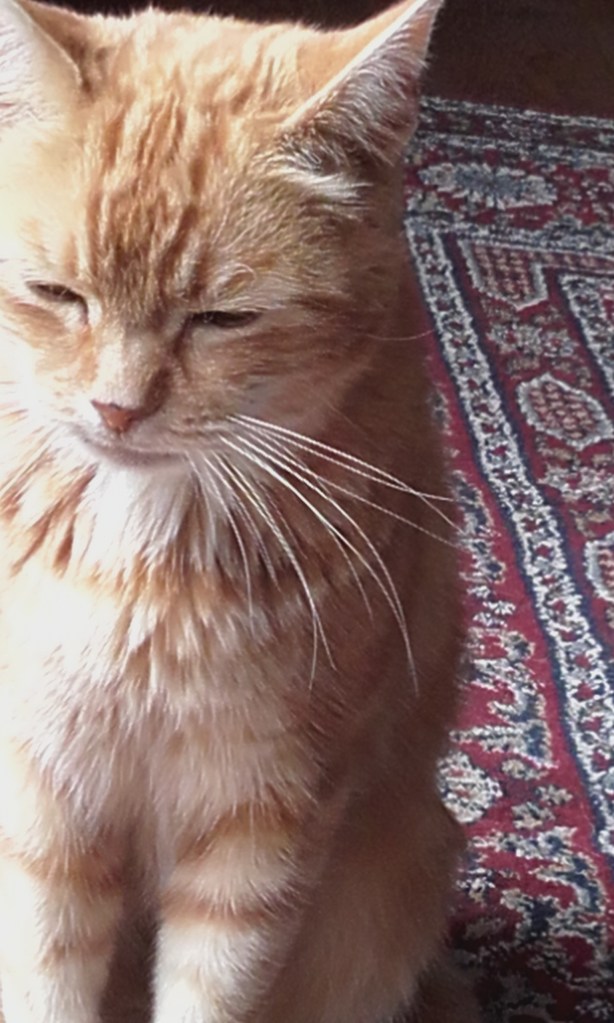
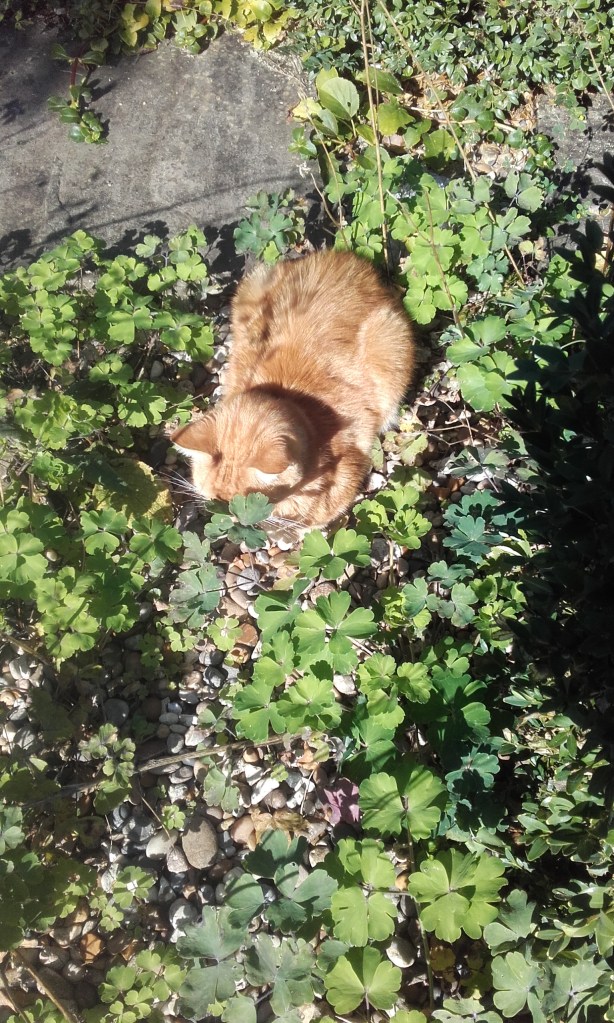
We lost our 12-year-old ginger cat Pastille on Wednesday night/Thursday morning.

She didn’t turn up for the Tuesday morning feed, then later staggered into the kitchen, struggling to walk. She eventually hobbled into the garden, curling up listlessly in a spot she had never frequented. We knew the signs.

Before the light faded, we took her in, and she spent her last 30 or so hours either flopped on a blanket or spreadeagled on a wicker basket. Head drooping, occasionally taking small mouthfuls of water, almost zero interest in the morsels of food we offered. As we went to bed Wednesday night, I lightly tickled her under the jaw, as she liked. Just for a second, she rubbed her head against my hand. “Night night baby,” I whispered.

Maureen woke me at 6.30 a.m., sobbing. Pastille was beside the basket, body stiff. Best guess is she died of kidney failure. We buried her in the garden that afternoon, topped with a rose.

It wasn’t unexpected. Pastille hadn’t enjoyed the move to my Dad’s house a year back, and never settled. She looked permanently unwell and out of sorts in the more cramped environment. I’m so glad she exited relatively swiftly and without a major struggle.  

She came into our life in autumn 2010. Cajoled by our daughter, we bought brothers Pastille and Pippa, and another kitten, Bob.

When they played together, rushing up and down the stairs, Pastille always came off worse. Slightly smaller, and less inclined to fight-play. So I made Pastille a promise: “I’ll always look after you.”

These pics from that time had tears streaming from my eyes.

Pastille and Pippa both had a sex change in early 2012. Pippa became pregnant and then the vet, when neutering Pastille, noticed she was female.

Pastille needed the most love of our brood, which numbered eight at one stage. As she grew, she insisted on eating separately from the others. If the litter tray was unclean, she would shit on carpets and under beds. She has been cursed more regularly by me than any of her peers. At our last two residences, the others all ventured out into the fields at the back, catching vermin that they brought back for our inspection. Pastille stayed in the garden, and often the house.

When she was about three, she was basking alone in the sun one day when a monster farm vehicle came thundering past in the field at the back, spraying fertiliser. I watched her sprint at greyhound speed towards the house, and then take off through the air where the grass stopped. She hit the back wall of the house about four feet up in the air, and then stayed at this height, running round two intersecting walls like Spiderman, before dropping down to ground level and fleeing into the house. Amazing and hilarious.

A fragile, flighty cat, she couldn’t climb trees properly, somehow getting her claws stuck. She was often plagued by fleas, despite various medications. And generally scared of humans, most noises and perhaps life itself. She might be a doe if she reincarnates.  

Many times, when I’ve been sitting quietly, she would noiselessly glide into position next to me. Or tentatively alight on my lap, in her braver moods. A purring would slowly make itself known, rumbling away like the inner voice of the earth. Her love was unconditional, never manipulative.

In our last house she found great peace in parts of the back garden area that I let become a wild meadow, stretching out in sunny solitude for hours.

Now there’s a bowl less at feeding time, and a body less near the lounge windows where the light pours in throughout the day. I still whisper to her when feeding the birds, or sitting near her grave in the sunshine, with a cuppa. Never loved a cat like that one.

Life gives and it takes. Just over a year ago, we still had six of the original eight. Now just four are left.

The black and white Daisy refused to move with us to Dad’s house, shacking up instead with one of the neighbours. With Pastille gone, it feels as if a special time may be finishing.

In her lifetime, I learned Buddhist meditations. I started to walk out in nature for hours on end. Learned not to trust the TV. Wrote my book, ‘Out of Essex’. Finally realised that newspapers are rarely more than arse-wipes with pictures. Grew vegetables again. Learned transcendental meditation. Started my blog. Became a carer.

Pastille was my little friend during a fascinating and memorable time. I’ll always be grateful for her company. Maybe we’ll meet up again, down the road.

In the meantime, I walk to her grave each evening and place four heavy pots around her rose, as protection against badgers and foxes that might fancy a buried meal.

A promise is a promise.

308. Almost gone

It’s been a year since we moved in with my father, on 30 September 2021. Not a happy year. But utterly memorable. We’ve kept him fed, watered, warm, fairly healthy, clean and, most importantly, we have kept him company.

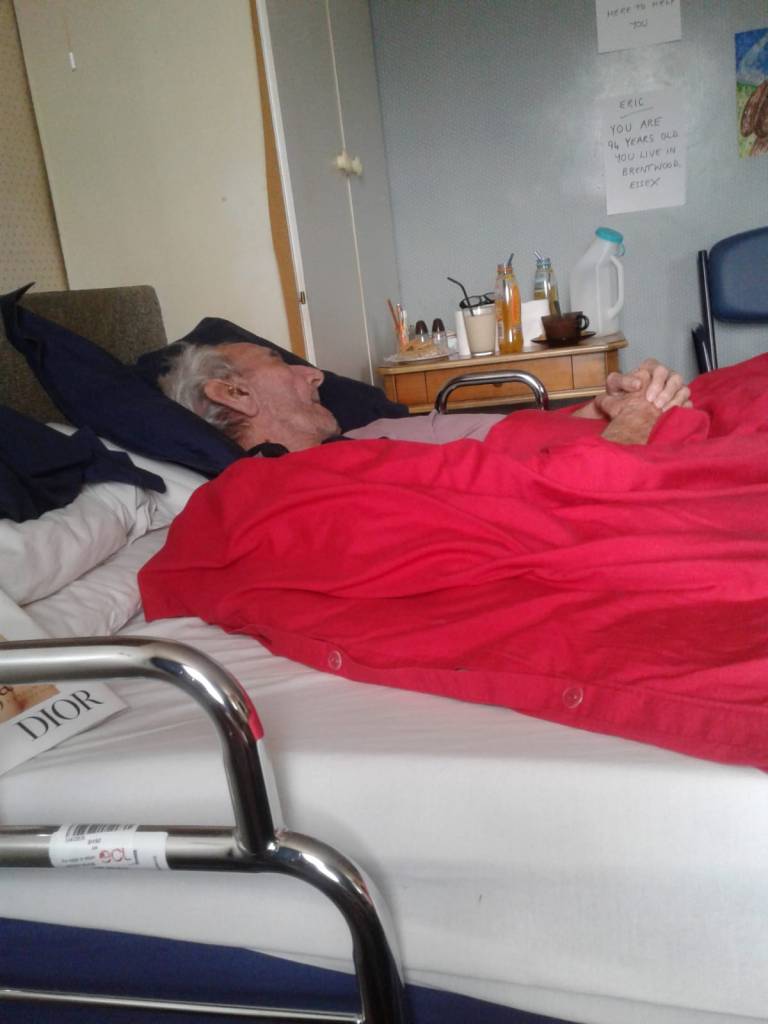
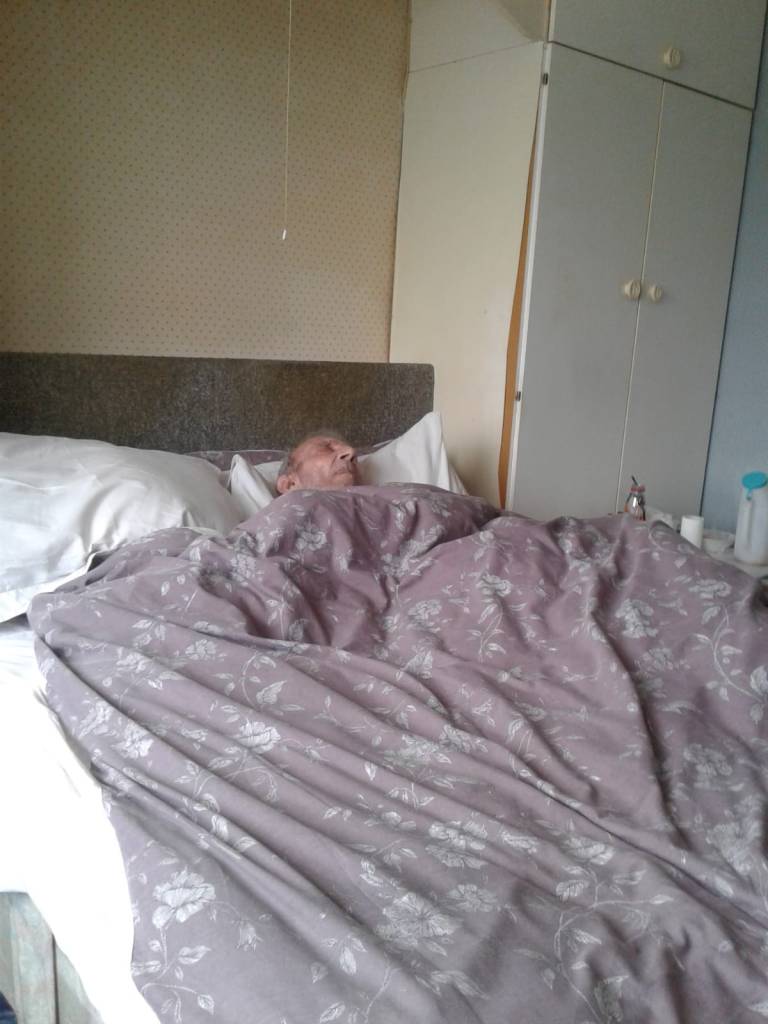
Eric will be 95 in January. He hasn’t left his bedroom for several months. No more power in his legs. He doesn’t eat much. He has a commode and a TV. Vascular dementia is slowly killing him. We leave out family pictures and photograph albums to jog his memory, which is riddled with supertanker-sized holes.

His questions on an average-to-bad day might include “are my parents alive”, “where do I live”, “are you my brother”, or “do I still go to work?” He has no short-term memory beyond 4-5 seconds, while his longer-term memories are patchy.

He was once a tough guy, who inspired my dread and admiration in equal amounts. It’s all there in Blog 260 (https://thebiscuitfactoryonline.com/2020/02/09/260-bad-company/).

Now his agency is almost gone. Odd splashes of ego and confidence remain, although he cannot read much or walk far.

Going to the toilet can be an effort. He prefers his drinks through a straw. Food with a spoon.

Living with Dad is like swimming through mud. Ensuring he gets drink inside him, fretting over his minimal appetite, worrying  constantly that he may be cold, uncomfortable, sad or lonely.  No holidays, few breaks. Anxiety.

Yet he brings unexpected and strange gifts. His past intermingles with the now. I awoke him one morning, but he couldn’t leave his dream. He was making a speech: “I’ve had a wonderful day that I’ll never forget, and you gentlemen have a wonderful golf club. Thank you so much.” (Was that an allegory for his life?)

Inadvertently, he makes us laugh. He likes his curtains drawn at night, so that no neighbour can see into his room. Even though his room is on the top floor of three, a light at night might make him viewable from houses higher up the street. I drew the curtains recently, only to be told that there was still a slight gap at the top. I pointed out this was too high for any neighbour to see in.

“What about airline pilots?” he replied.

The trick to keeping him buoyant is talk. Finding a subject that he partially recalls, then thoroughly exploring the topic, and all the offshoots. He was once a golf club secretary for five years, so we might chat about the members, the course, the sport, the bar, the staff, and so on. Maybe as we watch golf on TV. I make a note on my phone every time he vouchsafes a new detail. Then add it to the next conversation.

Maureen is also brilliant with him, but we have hit a towering problem. He recently resurrected a series of sleazy remarks that he made to my wife not long after we moved in. Blunt, unsubtle requests to fondle specified parts of her anatomy, and for her to reciprocate. Maybe he mistakes Maureen for his wife, who died in 2006 – or just sees any female visiting his bedroom as ‘fair game’. When the remarks emerge, they are often accompanied by attempts at self-pleasuring beneath the sheets. He cannot help himself. Maureen gets distressed: angry and upset. She withdraws from visiting his room for a few weeks. I get it. I fill in and step up a gear. Neither of us complains too much as it brings down the other.

Dad and I have unresolved tensions, forgotten by him. Rage leftovers from my childhood. I want to vent that occasionally, but he wouldn’t begin to understand.

Yet there is also a welcome intimacy that I would never have anticipated. Sitting him up in bed for his drinks requires that I nestle softly into his neck, my arms locked under his armpits, before lifting him up and back. We both smile at the effort. “I flew through the air,” he sometimes gasps. And I empty his bedpan, with its piss and stinking turds. I have helped clean his room after he tried to shit in a urine bottle.

It may seem odd, but intuition tells me that this closeness is healing, for both of us. And there is usually a chuckle around the corner, even if one party doesn’t see the humour.

Eric lives almost entirely on tea and custard creams. I took some up a while back and he noticed that one of the biscuits had a corner missing. He scrutinised it keenly, pointing his finger at the absent section and then looking me hard in the eyes. “Did you eat that?”

Until Dad started to suffer, I gave little consideration to dementia and related illnesses. The learning curve has been immense, witnessing a remorseless one-way condition. The blessing is that he forgets any woes almost as soon as he discovers them. He has become like a child, kicking his feet under the bedclothes as he goes to sleep.

We watch endless hours of sport, to help pass the time. One of the five cats we brought to his house generally jumps up on his bed while we view. Once, during a televised soccer game, his face crinkled in thought. “Do cats form football teams?” he asked.

I’ve discovered how much Dad loves language. I’m grateful, as I can see where I get it. He can still recite chunks from ‘The Charge of the Light Brigade’. At his East London junior school in Globe Road, Bethnal Green, he regularly used the same two words to win the weekly spelling competition. Unique and antique. The other kids weren’t interested. As his condition worsens, nursery rhymes fascinate him. ‘Jack Sprat’ mesmerises him. He puzzles over the meaning, wondering why Jack’s wife “would eat no lean”. If one of our felines jumps up while he ponders, he starts the rhyme again. “Black cats can eat no fat”.

Football chat animates him, taking in Eric’s first visits to Leyton Orient in the 1930s, or seeing Tottenham play Arsenal in the annual ‘Jubilee’ game each August. He marvels at an intrepid expedition south of the Thames (“like a foreign country”) to Charlton Athletic, where Derby County were the visitors. Dally Duncan and Sammy Crooks are two names he somehow remembers from the game.

Soccer talk invariably ends with the question of how much a ticket would cost now. When I suggest somewhere between £40 and £50 for a top game he explodes with surprise, indignation and laughter. “But it was threepence when I was a boy.” That conversation can take place ten or more times if we watch a game.

I try to be kind, tolerant and compassionate. I strive to treat him with the tenderness I would prefer if ever ending up in such frailty.

But, some days, just being in the same house is mentally exhausting. A ceaseless stress is his repeated requests for cigarettes. I explain dutifully that he has almost killed himself with fags, that he risks setting the bedclothes alight. He agrees that any more would be unwise. Two minutes later he asks if he can have a cigarette. The night hours can be ravaged by his cough, linked to the tapestry of scars on his lungs from 80 years of smoking.

I still work, in a small study just yards from his bed. My ears are always listening for his requests for help, or for the squeaking floorboards that tell of his short trip to the commode. I haven’t touched alcohol at home for months. Being drunk and caring don’t mix.  

The big daily pleasure, the Great Escape, is my four-mile afternoon walk at a local nature reserve.  And there is a morning break when the carers wash him. When my brother Neil stands in, Maureen and I enjoy delightful hours away. Usually the coast or the cinema.

Then it’s back to the circular reality of sitting by the bed, hoping the TV will preoccupy him or discussing his life. His father Harold’s death when Eric was just a toddler. The horse and cart that crashed through the window of his mum’s shop in Bethnal Green in the 1930s. His neighbour Podar Currie, whose family were so poor that there were no birthday presents. The firework that cost half a penny – known as the Boy Scout Rouser. Going to the speedway at Hackney Wick Wolves, with his cousins Terry and Alf, proudly wearing his red and gold scarf.

A good session plunges him into sleep for hours. Often preceded by the admission that he is “all mixed up”.

He recalls looking over his gran’s back wall in Moss Street at Oswald Moseley and his parading Black Shirts. He remembers London’s barrage balloons that were often released too late in the Blitz.

You learn to chip in with names and dates and events so that he forges on.

We talk of his evacuation to Norfolk and Staffordshire during WW2 with his grammar school. Meeting Kenny from Kennington and Ronnie and Renie from Ladbroke Grove. Then back to London, cruising the streets looking for dog ends. Classic line from Eric: “I would smoke anything that lit.” His first job at the Ardeth Tobacco Company. First girlfriend – Joyce Lewis.

In 1944 he joined the navy, aged 16. Trained as a coder.

Missed any WW2 combat. Sailed around the world, including Cape Horn, lingering longest in Ceylon. Demobbed at Whale Island, in Portsmouth, in 1948.

Back to East London (Homerton), he began work at Billingsgate fish market. Morning finishes, long sessions at Hackney public baths to wash away the stink. Going dancing at the Tottenham Royal on Saturday nights with his mates Wally Knight and Billy Tissle. Meeting Mum at Butlins in Skegness, marrying her in 1952.

After that, the haziness thickens. His football mates and his jobs flit in and out of his mind. I’m usually the one telling the story. Which is all he has to hang onto, for no more than a couple of seconds, before the void returns.

In the wider world, in 2022, there is deepening chaos. War, financial collapse, political deceit and ineptitude globally. I’m glad Eric cannot begin to comprehend the turmoil.

An odd vision came to me the other day. That Maureen and I are metaphorically protected, almost invisible, tucked away to the side, as we push Eric along his destined journey by night, in a cart or a wheelbarrow, while the warring troops sleep. He rests by day when battle recommences.

His involuntary humour helps keep us pushing. We were watching cricket the other day. He finished his cup of tea, and I handed him his two prescribed pills.

“Are there pills for cricket?” he asked.

“Dad…why would pills be needed for cricket?”

“To stop people falling asleep”.

My father the demented, dwindling genius.

We could put him in a home, but nobody would know him intimately, or truly care for him. He always said he wanted to die “in his castle”, so that’s the plan. On we go.

307. Contrasting fortunes

I met Rod in a Norwich pub. He was a mate of a mate. The beer was flowing on a Saturday night in the Fat Cat.

Rod sat on an adjacent stool. A friendly guy, confident but not arrogant. We got chatting.

It was spring 1994. Margaret Thatcher’s notions of a share- and property-owning democracy had taken root – and Rod was gripped by an idea. Owning not just one but a whole string of houses. He had started by using the ‘free money’ available from the British government’s initial privatisations of public utilities: British Telecom, British Gas and so on. He would apply for as many free shares as possible in each state company being flogged off, and then cash in by selling them.

He would put the profits towards a house deposit, buy a small property and get some tenants in to pay the mortgage, with some rent left over that went towards the next house deposit. And so on.

I was on a wilder track, obsessively refining a betting system with the aim of enriching myself. He correctly thought I was misguided and unlikely to succeed. I thought he was unknowingly helping to rip away some of the socialist fundamentals that held much of the UK together.

But each to their own path.

We spent an enjoyable hour in each other’s company and that night was the last I ever saw of him.

Our mutual friend Jonny Price told me three years ago that Rod had died, age 62, of suspected heart trouble. At the time of his passing, he owned “about” 103 properties with tenants.

I’m 65 now, no property to my name. My wife and I live with and care for my father, whose vascular dementia is steadily increasing. It is treacherously hard going at times, but Maureen and I usually get to sit in the morning sunshine and make each other laugh. A pleasure not to be under-estimated.

Meanwhile, the fullest fruits of privatisation are about to smash British life this autumn, as energy prices go ballistic. It won’t be pretty. Countless families will be choosing between heat and food. Some will borrow unaffordably to afford both. An estimated quarter of a million Brits are already homeless, many unable to pay the rents charged by private landlords.

Funny how things turn out. I’m not sure there are even any rules. We all play the hands we were dealt. As best we can. The cookie crumbles as it will.

Here’s a caricature of Rod drawn by a fellow ornithologist in the 1980s. I’m glad I got to meet him.